
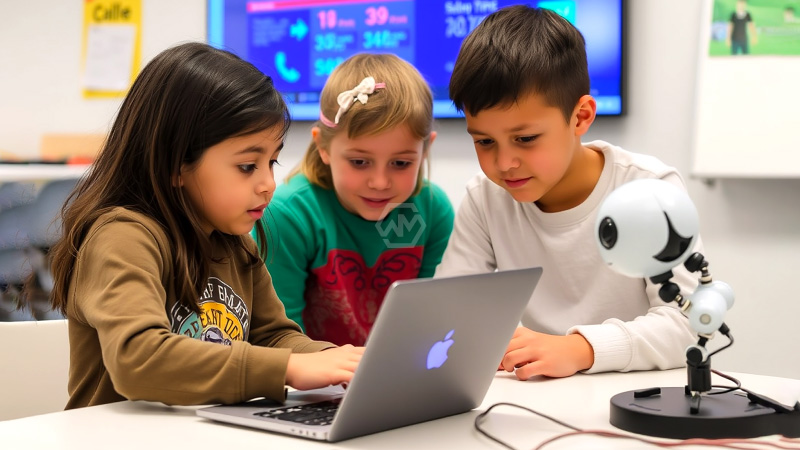
- AI tools assist students with idea generation, revisions, and writing feedback.
- Concerns exist about AI reducing critical thinking and oral communication.
- Teachers are divided on AI’s impact, with some fully embracing it and others banning its use.
AI is transforming literacy education by offering students real-time feedback and assistance in structuring their writing. Tools like ChatGPT, MagicSchool, and BriskBoost help students brainstorm and revise their essays, making the learning process more interactive and efficient.
However, the increasing reliance on AI has raised concerns about students losing essential writing skills and critical thinking abilities. Studies indicate that AI interactions are more mechanical than human conversations, potentially limiting language development.
AI and Literacy: A New Era in Education
AI-powered tools are revolutionizing how students engage with reading and writing, making the learning process more dynamic. These technologies help personalize instruction by catering to individual student needs, allowing them to work at their own pace. Some platforms even mimic one-on-one tutoring, ensuring that students struggling with literacy receive additional support.
Despite its benefits, AI is not a perfect substitute for human teaching. Writing requires creativity, analysis, and expression, which AI cannot fully replicate. The lack of real-world engagement with language, particularly in oral communication, may hinder a student’s ability to develop complex writing skills.
Teachers are adapting to this shift in different ways. While some embrace AI for brainstorming and revision, others, like Katie Thomas, worry that it encourages dependency. To counteract this, certain schools are reinforcing traditional writing methods, such as handwritten assignments, to maintain students’ cognitive engagement.
The future of AI in literacy education will likely depend on a balanced approach. Instead of replacing human instruction, AI should act as a complementary tool, enhancing learning while ensuring students continue to develop essential literacy skills independently.
AI in education is a powerful tool but requires careful integration. While it enhances learning, it should not replace fundamental literacy-building practices that develop critical thinking and creativity.
“Technology is just a tool. In terms of getting the kids working together and motivating them, the teacher is the most important.” — Bill Gates