
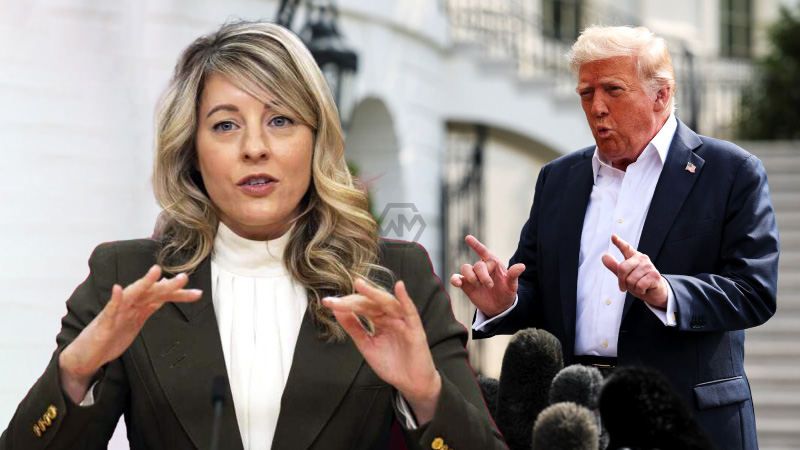
- Industry Minister Joly says Canada will prioritize economic resilience and diversification.
- Trump threatens 35% tariffs, citing trade deficits and false fentanyl claims.
- Canada readies countermeasures while pursuing deeper ties with global partners like the EU.
Canada is preparing for turbulent trade negotiations after former U.S. President Donald Trump threatened to impose a 35% tariff on Canadian goods by August 1. Industry Minister Mélanie Joly responded firmly, calling the moment “not normal times” and emphasizing Canada’s intent to protect jobs and workers through strategic economic diplomacy.
Trump’s justification for the tariffs—alleging fentanyl trafficking from Canada—has been widely disputed, including by U.S. government data and independent research, which points to Mexico as the primary source.
Ottawa Pushes Back: Canada Seeks Stability Amid Trump’s Tariff Ultimatum
Mélanie Joly clarified that Canada will not engage in public back-and-forths with Washington but noted that Canada stands out globally—second only to China—in the number of counter-tariffs imposed in recent years. She stressed that Canada’s retaliatory toolkit remains active and available. The focus now, she said, is preserving Canada’s long-term trade credibility and ensuring businesses remain confident in international markets.
The proposed tariffs have already drawn criticism across Canadian provinces. Nova Scotia Premier Tim Houston called Trump’s approach “childish bullying,” asserting that Canadians are beginning to boycott U.S. products and cancel cross-border trips. Such grassroots economic pushback could influence consumer behavior if tensions persist, particularly in border provinces reliant on bilateral trade.
Canada’s pivot away from a U.S.-centric trade strategy is increasingly visible. New agreements with the EU, Indo-Pacific partners, and South America are being framed as buffers against American unpredictability. Joly reiterated that open and fair trade remains a core Canadian value and that isolationist rhetoric from the U.S. won’t deter Canada from advancing globally.
Despite the fiery rhetoric, a U.S. administration official stated that no final decision has been made and that goods protected under the CUSMA agreement will remain exempt. Still, the timing of Trump’s letter—coinciding with sensitive negotiations—has left officials scrambling for clarity. Canada continues to press for transparency and predictability in trade, warning that erratic policy can harm both sides of the border.
Canada’s response to Trump’s tariff threat highlights a broader shift toward trade resilience, diplomacy, and diversification in an era of growing global uncertainty.
“When one door closes, another opens; but we often look so long and so regretfully upon the closed door that we do not see the one which has opened.” — Alexander Graham Bell