
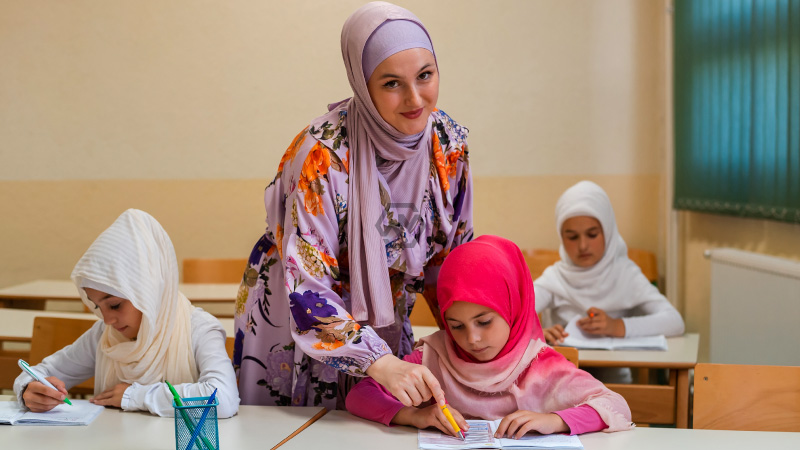
- Arabic will be taught daily for 40 minutes in all UAE private kindergartens by 2025/26.
- New curriculum also mandates Islamic Studies and Social Studies.
- Aims to foster national identity and cultural awareness from an early age.
In a major educational reform, the UAE Ministry of Education (MOE) has announced that all private schools across the Emirates must introduce daily Arabic lessons for kindergarten students, starting from the 2025/2026 academic year.
The updated curriculum goes beyond language, incorporating Islamic Studies and Social Studies into the kindergarten syllabus. Muslim children will receive 90 minutes of Islamic education weekly, delivered in either two or three sessions.
New UAE Education Policy Brings Arabic and Culture to the Heart of Kindergarten Learning
This landmark policy aligns with broader national strategies emphasizing the preservation and promotion of Emirati heritage. By embedding Arabic and Emirati cultural values at the kindergarten level, the MOE aims to nurture a generation that is fluent in its mother tongue and deeply connected to its roots and traditions. Instruction will be carried out by trained early childhood educators using MOE-approved teaching materials tailored to the developmental needs of children aged four and above.
To ensure successful implementation, the MOE will supply schools with detailed instructional frameworks and defined learning outcomes for all three mandated subjects—Arabic, Islamic Studies, and Social Studies—before the start of the new academic year. Schools will undergo advisory visits in the initial stages, and formal compliance inspections will begin in the 2026/2027 academic year, jointly managed with local educational authorities.
This move follows similar initiatives in Abu Dhabi and Sharjah, where local education departments have emphasized integrating Arabic language instruction and national identity values into private education. Abu Dhabi’s National Identity Mark, for instance, assesses schools on how effectively they incorporate Emirati heritage and values into their curriculum. The national plan now takes this vision to a unified, country-wide level.
Leaders across the Emirates have long championed Arabic’s importance. In 2022, Sheikh Dr Sultan bin Muhammad Al Qasimi highlighted Arabic as “a stockpile of our history, our knowledge, and our culture.” In 2023, Sheikh Abdullah bin Zayed emphasized the need to foster Arabic skills in youth to preserve cultural unity. The new curriculum policy echoes these sentiments, reinforcing Arabic’s role as a unifying force among citizens and residents alike.
By weaving language, faith, and cultural values into early education, the UAE is laying the foundation for a generation that is linguistically empowered, culturally aware, and socially grounded.
“The Arabic language is what unites us from the far East to the far West.” — Sheikh Dr Sultan bin Muhammad Al Qasimi