
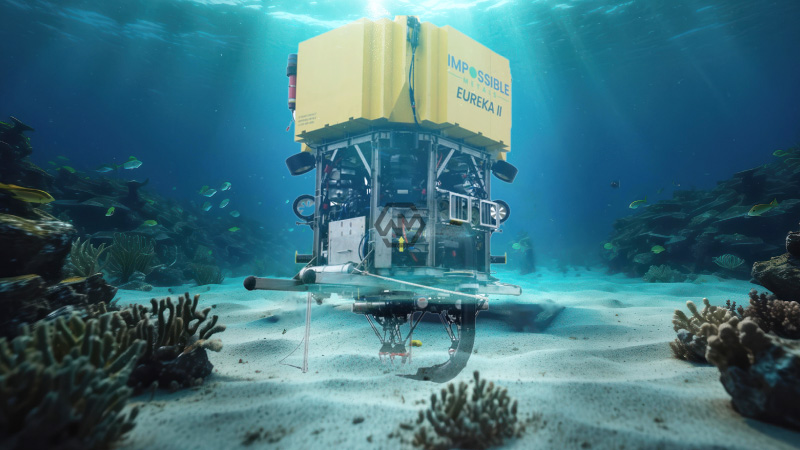
- Robot uses AI to selectively collect deep-sea metals without disturbing aquatic ecosystems.
- Tested in Canadian lake before future deployment in Pacific waters.
- Aims to meet rising demand for critical minerals with minimal environmental impact.
Impossible Metals, a California-based startup, is pioneering a gentler approach to deep-sea mining by developing an autonomous robot that identifies and collects polymetallic nodules without dredging the seabed.
Unlike traditional underwater mining methods, which often involve bulldozing vast seabed areas and generating harmful sediment plumes, this robot operates with precision and restraint.
AI Robot Paves New Path for Eco-Friendly Deep-Sea Mining
The robot, developed by Impossible Metals, was recently tested in a Canadian lake as part of early-stage trials for a new mining approach. Controlled remotely from a lab using game-like interfaces, the robot uses lights, cameras, and AI to identify and gently collect polymetallic nodules—key sources of nickel, copper, and cobalt.
This new method offers a stark contrast to the conventional practice of dragging heavy machinery along the seabed, which stirs up large clouds of sediment and can harm marine ecosystems. The robot’s ability to “see” and avoid marine life is seen as a possible game-changer for environmental sustainability in mining.
However, critics like marine biologist Douglas McCauley warn that even low-impact collection methods carry risks, particularly because the nodules themselves are slow-forming and host unique marine organisms. Their removal could permanently alter fragile deep-sea ecosystems that take centuries to recover.
Impossible Metals acknowledges these limitations but maintains that some disruption is inevitable to meet global mineral demands. The company plans to leave 60% of the nodules untouched and aims to deploy its commercial-scale robot, Eureka 3, by 2026 with full autonomy and increased harvesting capacity.
While the technology offers a promising step toward sustainable ocean mining, experts stress the need for caution and further research to avoid repeating past environmental mistakes on the seafloor.
“We need a lot more critical minerals, as we want to electrify everything.” – Oliver Gunasekara, CEO of Impossible Metals