
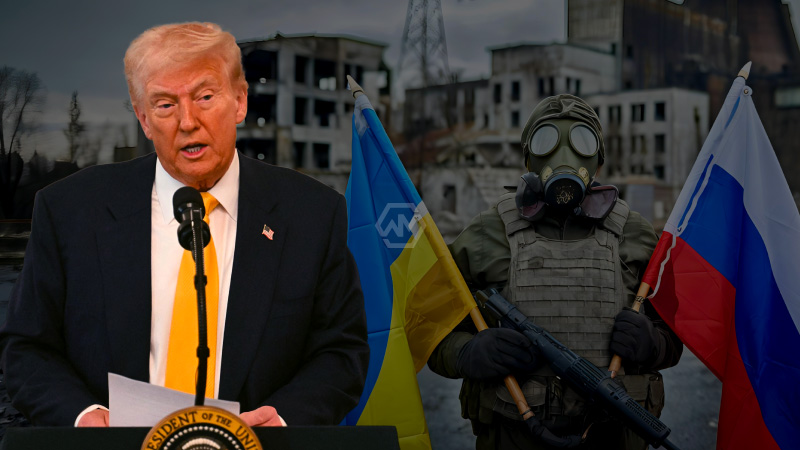
- Trump warns Russia with an August 8 ceasefire deadline, threatening new sanctions.
- Aide accuses India of indirectly funding the war through Russian oil purchases.
- Ukraine escalates drone strikes on Russian infrastructure, damaging railways and energy facilities.
Former U.S. President Donald Trump has issued a stark ultimatum to the Kremlin, calling for a complete ceasefire in Ukraine by August 8. According to his deputy chief of staff, Stephen Miller, Trump is prepared to enforce harsh sanctions if Vladimir Putin fails to comply.
Meanwhile, Ukraine continues to intensify its drone warfare campaign, launching coordinated strikes on Russian oil refineries, railway control centers, and infrastructure linked to missile and space programs.
Deadline and Drones: Trump’s Warning to Russia as Ukraine Hits Key Infrastructure
Trump’s hardline stance comes as he positions himself as a global peace negotiator ahead of the 2025 U.S. election. His move to send special envoy Steve Witkoff to Moscow suggests a last-minute diplomatic push before sanctions take effect. The ultimatum also signals a potential shift in U.S. policy, particularly if Trump returns to office with an aggressive peace-brokering agenda.
Stephen Miller’s sharp criticism of India adds a new layer of international complexity. He claimed that India’s oil trade with Russia has reached levels comparable to China, raising alarms about indirect support for Putin’s war. The U.S. administration’s rhetoric suggests increased scrutiny of India’s energy policy and its potential ramifications on Ukraine.
Ukraine’s recent strikes demonstrate a strategic pivot from defense to disruption. Attacks on critical rail lines in Volgograd and power stations in Tambov signal Kyiv’s aim to cripple logistical and military operations deep inside Russian territory. These strikes have forced the closure of airspace and delayed critical transport routes, adding internal pressure on Russia’s already stretched resources.
Public reaction inside Russia is also evolving. The arrest of three young Russians in Sochi for filming themselves in front of a burning oil depot highlights rising domestic sensitivity to wartime optics. Charged with violating emergency protocols, their case reflects the Kremlin’s attempt to maintain control over wartime narratives and public morale.
As Trump steps up diplomatic pressure and Ukraine escalates its battlefield tactics, the war enters a volatile phase where geopolitical influence and military precision converge.
“In war, truth is the first casualty.” – Aeschylus