
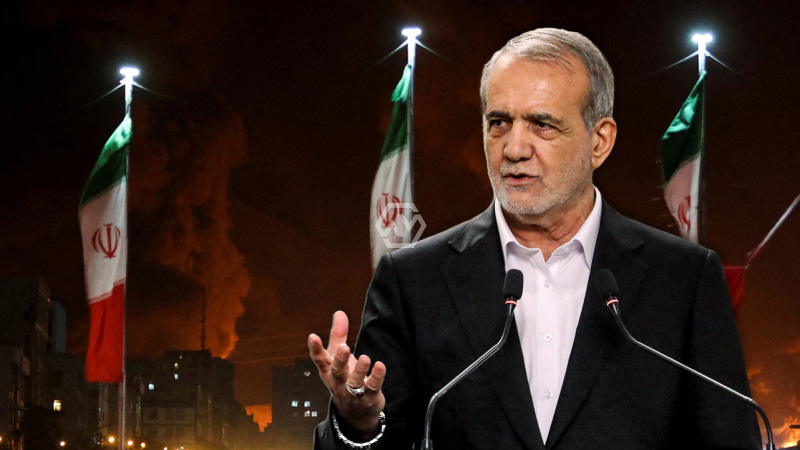
- Iranian President Masoud Pezeshkian was injured during an Israeli missile strike on a Tehran compound on June 16.
- The attack targeted a high-level security meeting attended by Iran’s top civilian and military leaders.
- Iranian authorities suspect internal betrayal, citing the operation’s precision and resemblance to Nasrallah’s assassination.
Iranian state-linked sources report that President Masoud Pezeshkian sustained a leg injury during an Israeli missile strike on June 16, amid a 12-day war that shook the Middle East.
Iranian authorities are now probing the likelihood of an internal leak that enabled such precise targeting. Fars News, affiliated with the Islamic Revolutionary Guard Corps (IRGC), stated that six missiles were used in the attack and confirmed that Pezeshkian was slightly wounded while fleeing.
Inside the Strike: Iran Probes Israeli Plot That Wounded Its President
The Israeli strike marks a significant escalation in the country’s covert operations, transitioning from sabotage and cyberattacks to direct attempts on top Iranian leadership. The June 16 attack followed a surprise Israeli offensive that began on June 13, leading to swift aerial exchanges and the assassination of several top Iranian military figures, including IRGC commander Maj. Gen. Hossein Salami and Armed Forces Chief of Staff Maj. Gen. Mohammad Bagheri.
Israel’s Defense Minister Israel Katz later confirmed that eliminating Supreme Leader Ayatollah Ali Khamenei was a key objective, though intelligence failed to provide a suitable opportunity. The attempt on Pezeshkian, while unsuccessful in terms of a full assassination, sent a clear message about the reach and boldness of Israeli operations. It also exposed serious vulnerabilities within Iran’s internal security and intelligence framework.
The attack also marked the first time an Iranian president was directly harmed in a foreign strike on home soil. Despite Iran’s swift retaliation—launching over 500 missiles and 1,100 drones toward Israeli targets—most of the leadership structure remained intact, albeit shaken. Analysts suggest the psychological impact of the attack on Iran’s political hierarchy could be more profound than the physical damage itself.
With the war concluding through a U.S.-brokered ceasefire, regional tensions remain high. Washington’s military support for Israel, including strikes on Iran’s nuclear sites, reignited debates over Middle Eastern stability and the future of non-proliferation efforts. Pezeshkian’s survival has become symbolic—proof of resilience to some and evidence of vulnerability to others.
The attempted assassination of President Pezeshkian underscores the escalating risks of regional warfare, where intelligence precision and preemptive strikes now define modern conflict. As Tehran confronts the aftermath, the war’s legacy is likely to shape Iran’s strategic doctrine for years to come.
“The supreme art of war is to subdue the enemy without fighting.” — Sun Tzu