
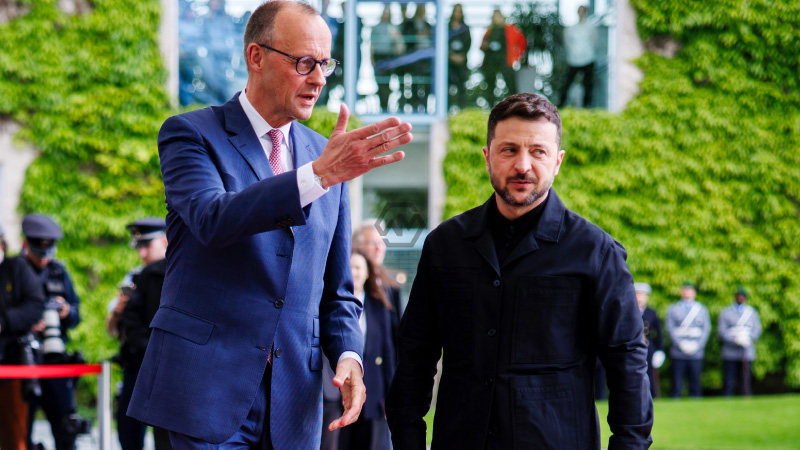
- Germany and Ukraine to co-produce long-range missiles amid ongoing war.
- €5 billion German aid package announced in response to Russian airstrikes.
- Ukrainian drones strike Russian military factories near Moscow.
Germany has announced a significant escalation in its military support for Ukraine by agreeing to co-manufacture long-range missiles with Kyiv. This move, revealed during President Zelenskyy‘s visit to Berlin, marks a strategic shift in European support as Ukraine seeks to bolster its defense capabilities against Russian aggression.
In tandem, Germany unveiled a €5 billion aid package, aimed at replenishing Ukraine’s arsenal and reinforcing its defenses after recent Russian missile and drone strikes on civilian targets.
Ukraine Hits Back: German Missiles, Drone Strikes Deep Inside Russia
Ukrainian drone strikes have targeted Russia’s defense infrastructure near Moscow, damaging facilities tied to the production of drones and cruise missiles. The Dubna Engineering Plant, affiliated with the Kronshtadt Group, was hit along with the Raduga Machine-Building Design Bureau. These locations are key to Russia’s drone and missile warfare against Ukraine.
The strikes appear to be part of a calculated Ukrainian effort to disrupt Russia’s weapons manufacturing capacity. Videos verified by open-source analysts show explosions and fire damage in facilities that have long supported Russia’s aerial assault strategy. Ukrainian officials confirmed the operations, branding the plants as critical nodes in the Russian war effort.
Meanwhile, President Zelenskyy used his platform in Germany to urge the United States to intensify sanctions on Russia. He emphasized that sanctions are gradually impacting Russia’s industrial base, but stressed that firmer and faster action from the U.S. would help shorten the war.
The growing alignment between Ukraine and Germany is reshaping Europe’s defense posture. As Germany strengthens its role in arms production and aid delivery, it signals a shift from cautious supporter to active participant in countering Russian aggression. Moscow’s backlash indicates how significantly this new phase may alter the conflict’s dynamics.
As Ukraine and its allies ramp up coordinated strikes and military cooperation, the war continues to evolve into a high-tech battle of endurance, with Western aid now directly influencing production and strategic targeting.
“Russia is not willing to talk about a ceasefire, so the US Congress needs to approve sanctions. When that happens, the war will end more quickly.” – Volodymyr Zelenskyy