
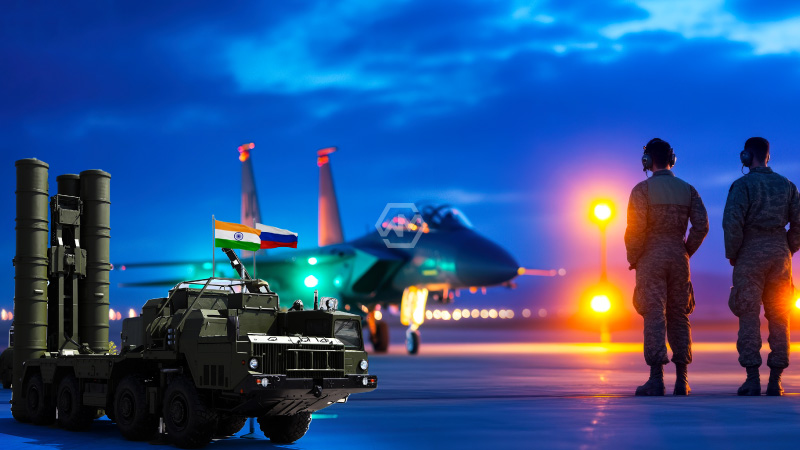
- Defence ministers from India and Russia met on the sidelines of the SCO summit in Qingdao, China.
- Talks focused on pending S-400 air defence system deliveries and Su-30 MKI fighter jet upgrades.
- India seeks expedited military hardware amid regional security tensions with Pakistan and China.
India’s Defence Minister Rajnath Singh held high-level talks with Russian counterpart Andrey Belousov during the SCO Defence Ministers’ Meeting in Qingdao on 26 June 2025.
The meeting also covered critical Su-30 MKI upgrade plans, aiming to modernize India’s most widely used fighter aircraft with advanced avionics, sensors, and precision weapons.
Strategic Realignment: India, Russia Push Forward on S-400 and Su-30 Modernization Amid Border Challenges
The S-400 Triumf, acquired under a $5.43 billion deal in 2018, remains one of the most advanced surface-to-air missile systems in India’s arsenal. Each squadron comprises 118 missiles, capable of neutralizing threats up to 400 kilometers away. While the delivery of three squadrons has fortified India’s defence posture, the remaining two are critical for ensuring multi-layered aerial defence, particularly given renewed concerns about airspace incursions and drone warfare.
India’s Su-30 MKI fleet, jointly produced by Hindustan Aeronautics Limited (HAL) in collaboration with Russian entities, forms the backbone of the Indian Air Force. The proposed upgrades—expected to include radar enhancements, electronic warfare systems, and integration of BrahMos missiles—will significantly boost the combat performance of this fourth-generation fighter jet, extending its operational relevance well into the 2030s.
This high-level interaction also reaffirms Russia’s commitment to maintaining its role as India’s key defence supplier, despite increased scrutiny due to its war in Ukraine. While India has diversified its military procurement sources in recent years—including partnerships with France, the US, and Israel—Russia continues to support legacy systems and provide technology transfers essential for India’s Make in India defence manufacturing program.
On a geopolitical front, Rajnath Singh’s parallel dialogue with Chinese Defence Minister Adm. Dong Jun underscored India’s intent to de-escalate border tensions while seeking a “permanent solution” to boundary disputes. Singh emphasized the importance of rebuilding trust post the 2020 Galwan clash and called for structured engagement mechanisms to prevent future flare-ups along the Line of Actual Control (LAC).
key defence platforms while engaging diplomatically with China reflects a strategic balancing act—one rooted in operational urgency and long-term regional stability.
“In preparing for battle I have always found that plans are useless, but planning is indispensable.” – Dwight D. Eisenhower