
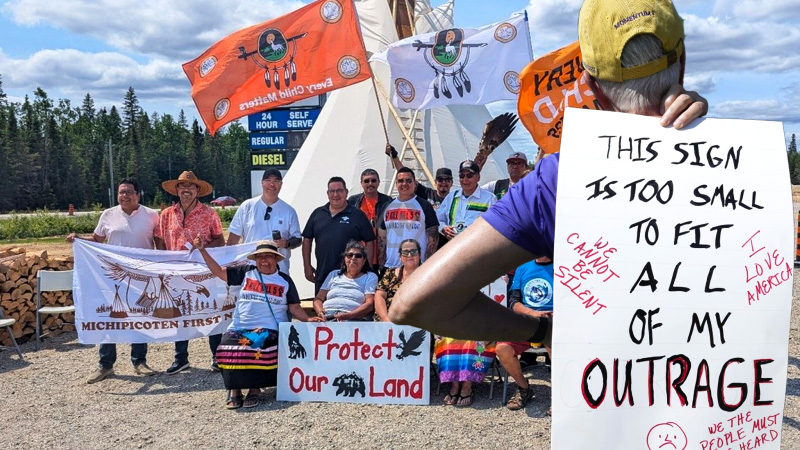
- Netmizaaggamig Nishnaabeg First Nation protested recent mining laws along Highway 17 in Ontario.
- Indigenous leaders say new legislation undermines their rights and excludes consultation.
- U.S.-Canada trade negotiations continue, with no firm commitment from the U.S. ambassador.
In northern Ontario, the Netmizaaggamig Nishnaabeg First Nation led a four-day demonstration along the Trans-Canada Highway to oppose newly passed legislation that aims to fast-track mining and development.
On the diplomatic front, Canada’s trade relationship with the United States remains uncertain. U.S. Ambassador Pete Hoekstra declined to commit to Prime Minister Mark Carney’s July 21 deadline for a new bilateral trade agreement.
Highway Demonstrations and Trade Deadlines: Canada Navigates Indigenous Rights and U.S. Demands
The peaceful protest along Highway 17 disrupted traffic but aimed to draw attention to the erosion of Indigenous rights in federal and provincial legislation. The demonstration was organized not to block development, but to demand respectful and inclusive governance. Chief Kwissiwa said both bills represent a “top-down” approach that disregards First Nations’ treaty rights and their role as stewards of their lands.
Bill C-5, recently passed at the federal level, enables the government to streamline major infrastructure and mining projects deemed in the national interest. Simultaneously, Ontario’s Bill 5 grants the provincial cabinet authority to override existing laws in designated economic zones, including environmental and municipal regulations. These legislative changes have sparked growing concern among Indigenous communities who say they were not adequately consulted.
As these domestic tensions escalate, Canada also faces pressure on the international trade front. Prime Minister Carney has made it clear that if no new trade agreement is reached by July 21, Canada will increase countermeasures in response to existing U.S. tariffs. However, Ambassador Hoekstra emphasized that while negotiations are active, no fixed timeline can be guaranteed.
The trade discussion is unfolding amid a backdrop of rising protectionism and shifting global alliances. Analysts note that while both governments have expressed optimism about reaching a deal, the underlying tone suggests a transactional relationship. For Canada, maintaining strong economic ties while asserting national and Indigenous interests is becoming an increasingly delicate balancing act.
Canada stands at a pivotal moment, challenged to uphold Indigenous rights at home while navigating complex trade diplomacy abroad.
“Injustice anywhere is a threat to justice everywhere.” – Martin Luther King Jr.